- DISCOVERING AI: Igniting Human Potential
- Posts
- Whether Your Child Uses AI or Avoids It, Parenting Just Got More Complicated
Whether Your Child Uses AI or Avoids It, Parenting Just Got More Complicated

Amy Love
January 14, 2026

DISCOVERING AI: Igniting Human Potential
By Amy D. Love, Founder of DISCOVERING AI and of the Global FAMILY AI GAME PLAN initiative
AI did not enter family life with a clear moment of arrival.
It showed up quietly in homework help, writing suggestions, search results, study tools, and everyday apps. For many parents, the first sign was not excitement or clarity. It was uncertainty.
That uncertainty is understandable. AI is often framed as a school issue or a workplace issue. Something teachers will handle. Something employers will figure out.
The reality is simpler and more personal.
AI is now a parenting issue.
Not because parents need to become experts in technology. Because parents are the ones shaping how children think, learn, struggle, and explain their work in a world where AI is increasingly present.
This is already happening, whether families opt in or not
Current research shows that AI is already embedded in students’ daily learning. Surveys indicate that more than half of K–12 students report using AI tools for homework or studying, and a growing share say they use AI daily for school-related tasks. Students themselves say that understanding AI matters for their future, even when adults feel unsure how to guide it.
This aligns with what I explore in RAISING ENTREPRENEURS: Preparing Kids for Success in the Age of AI. AI does not simply change access to answers. It changes how children approach effort, problem-solving, and confidence long before parents see changes in grades or outcomes.
That makes parenting attention essential, not optional.
Why this is not just something schools can handle
Schools are responding to AI in real time. Teachers are rethinking assignments and assessment. Districts are developing guidelines. Policymakers are emphasizing AI literacy.
Those efforts matter.
What schools cannot do is set family values or shape the daily habits that influence how children decide to use or avoid a tool when no adult is watching.
When a child chooses whether to wrestle with a problem or ask a tool for help, that choice is not technical. It reflects beliefs about learning, effort, and integrity.
Those beliefs are formed at home.
That is why parenting plays such a critical role here.
The first misconception: “My child does not use AI”
Some parents feel reassured when a child says they do not like AI or do not want to use it. I recently spoke with a parent whose school asked families to complete the FAMILY AI GAME PLAN. Their response was immediate.
“My child does not want to use AI. My child gets upset when I use AI for work. We are not completing it.”
That reaction makes sense. It also misses an opportunity.
A child who avoids AI still has beliefs about it. Those beliefs may come from fear, fairness concerns, identity, or confusion. Avoiding the conversation does not resolve those beliefs. It leaves them unexamined.
In DISCOVERING AI: A Parent's Guide to Raising Future-Ready Kids, I explain why values matter more than rules in fast-changing environments. Tools evolve quickly. Rules struggle to keep up. Values guide decisions across situations, even when adults are not present.
The FAMILY AI GAME PLAN is not about encouraging AI use. It is about helping families articulate when AI supports learning, when it gets in the way, and how values guide choices in different contexts.
Avoidance is still a relationship with AI. Guidance makes that relationship intentional.
The second misconception: “I would know if my child was using AI”
Many parents assume AI use would be obvious. A dramatic shift. Perfect answers. A clear red flag.
In reality, AI often blends into tools children already use. Writing suggestions, summaries, search enhancements, study aids. Students do not always label these as AI. They experience them as help.
At the same time, research shows that parents who feel uncertain about AI are more likely to disengage, while parents who engage, even imperfectly, feel more confident and connected to their child’s learning.
This is where a small shift in conversation makes a big difference.
Instead of asking, “Did you finish your homework?”
Ask, “How did you come up with that answer?”
In RAISING ENTREPRENEURS, I emphasize that explanation reveals learning in ways output never can. A child who can explain their thinking is developing understanding. A child who cannot explain is relying on something else to do the thinking for them.
That difference only becomes visible through conversation.
The third misconception: “We will figure it out later”
Waiting can feel reasonable. Many parents assume clearer rules will emerge or schools will resolve this first.
History suggests otherwise.
Families waited with social media. Norms formed without them. Habits solidified before values were articulated. Regaining influence later proved far harder than shaping expectations early.
AI is earlier in that cycle.
Researchers in education and child development consistently find that AI can support learning when paired with adult guidance, and that it does not replace human interaction, judgment, or reflection. Parental involvement remains essential.
Waiting is not neutral when systems evolve quickly. Defaults form fast.
Why this matters for your child’s future
The world children are preparing for is changing. Educators and employers increasingly emphasize skills like explaining reasoning, evaluating information, adapting to new tools, and exercising judgment.
These themes run throughout RAISING ENTREPRENEURS: Preparing Kids for Success in the Age of AI and DISCOVERING AI: A Parent's Guide to Raising Future-Ready Kids. Knowledge alone is no longer enough. How children think matters as much as what they produce.
Parenting purpose stays steady, even as tools change.
Children still need adults who help them build confidence, integrity, and clarity about how they learn and who they are becoming.
What parents can do this week
This does not start with rules. It starts with conversation.
Set aside ten minutes. No lecture. No agenda.
Try one question:
Where have you noticed AI showing up, even indirectly?
What feels helpful about it?
What feels uncomfortable?
When does AI support learning?
When does it get in the way?
Listen more than you speak.
From there, completing the FAMILY AI GAME PLAN becomes a natural next step. It turns assumptions into shared understanding. It aligns home and school. It gives children clarity instead of guesswork.
Join the conversation
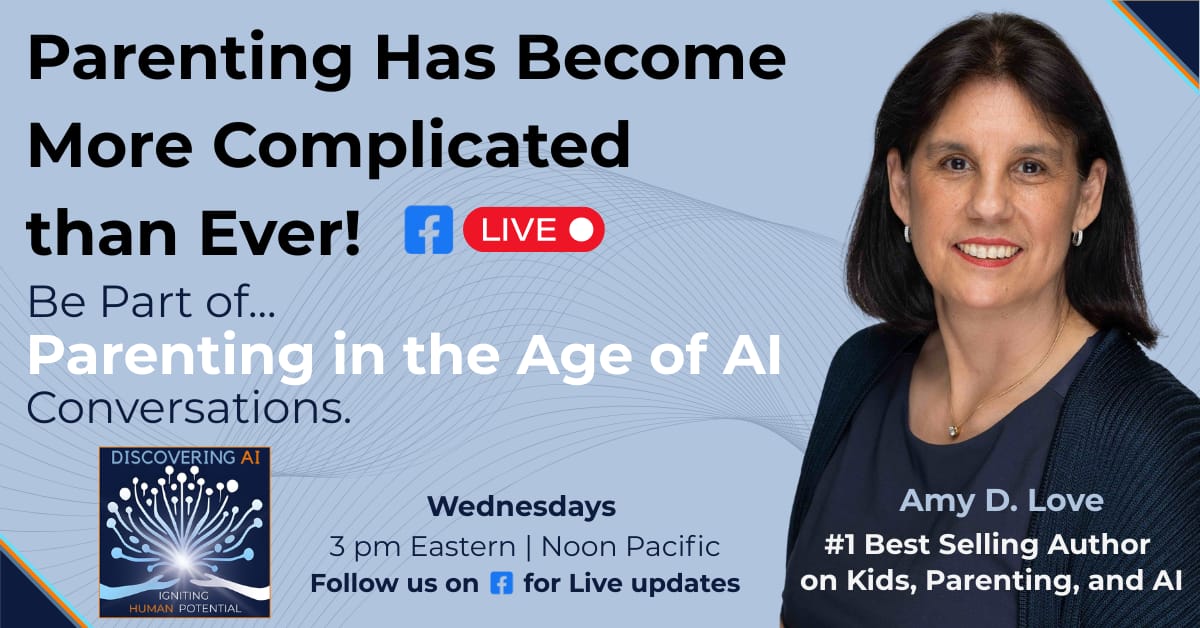
This week, I am launching a weekly Facebook Live series called Parenting in the Age of AI.
Thirty minutes. Once a week.
Each conversation is designed to give parents:
Clarity about what is changing
Confidence in how to respond
Stronger connection through better conversations at home
You do not need technical expertise. You do not need perfect answers. You simply need to stay in the conversation.
This first session focuses on why AI is now a parenting issue, even for families who think it does not apply to them.
If this article resonated, join me live this week. Follow me on Facebook to receive the reminder and link when we go live and subscribe to the DISCOVERING AI newsletter.
Come curious. Leave clearer.
Want to learn more? Follow 💠 Amy Love 💠on LinkedIn or Facebook and subscribe to the DISCOVERING AI newsletter.